IRIntellrise

Get a free AI key in 60 seconds

Intellrise is bring-your-own-key (BYOK) — and that is the same requirement whether your data sits in a database, a Google Sheet or a CSV. Creating a free Google Gemini key takes about a minute and no credit card. Deciding which key to point at confidential data, and what that key can cost you, is the part of this page worth reading slowly.

Why you need your own key

Every Intellrise plan is bring-your-own-key (BYOK): you connect your own AI provider key, and the AI runs on it. That keeps usage and cost in your control, and it means we never train on your data — but the same design puts your provider's terms, not ours, in charge of what happens to the data once it arrives, and on a free tier those terms are usually not the same as on a paid one. Read the note below on free versus billing-enabled keys before you point a key at anything confidential.

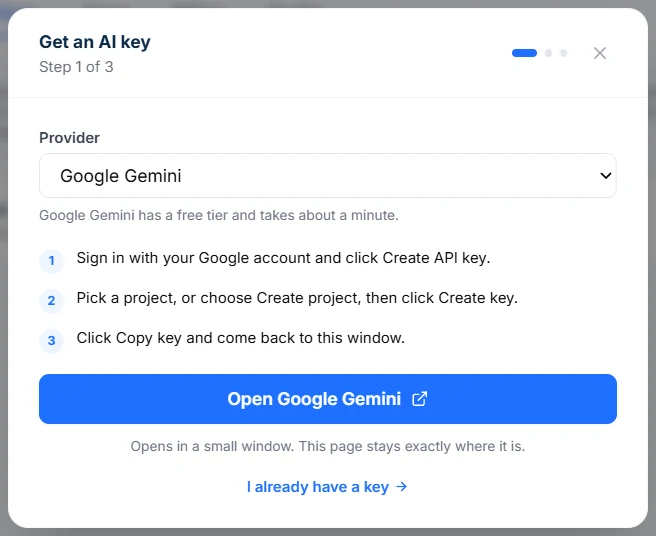
Google AI Studio gives you a Gemini key for free, and creating one does not ask for a card. The free-tier request limits are not published in Google's docs any more — its rate-limit page says they “can be viewed in Google AI Studio” (read 28 August 2026) — so we won't put a number on them here. That's the quickest way to get started, but you can use any supported provider: Google Gemini, OpenAI, Anthropic (Claude), DeepSeek, MiniMax, or any OpenAI-compatible endpoint you point us at.

One thing to know before you point that key at confidential data, because the free tier is not the same deal as the paid one: Google's Gemini API terms (effective 23 March 2026, read 28 August 2026) say that for Unpaid Services "Google uses the content you submit to the Services and any generated responses to provide, improve, and develop Google products and services and machine learning technologies", and the same page says "Do not submit sensitive, confidential, or personal information to the Unpaid Services." Between those two sentences Google's terms carry a third that a vendor review will ask about and that we had left out: "To help with quality and improve our products, human reviewers may read, annotate, and process your API input and output." Google says it takes steps first — "disconnecting this data from your Google Account, API key, and Cloud project before reviewers see or annotate it" — which unlinks who sent it, not what it says, so your table and column names are still in what a reviewer would read. A key on a Cloud project with an active billing account is a Paid Service, and there Google's terms say it "doesn't use your prompts ... or responses to improve our products". The paid branch has a cost of its own, and it belongs next to the recommendation rather than in a footnote: the same terms say "For Paid Services, Google logs prompts and responses for a limited period of time", for abuse detection and any legally required disclosure. And if you are in the EEA, Switzerland or the UK, those paid terms cover the free quota too. So: free key to try it on data you don't mind sharing with Google, billing-enabled key (or another provider) for the real thing. If you are not sure which of the two you are, the test is simple: if you have never set up billing on the Google Cloud project behind your key, you are on the Unpaid Services, and the Unpaid wording above is the one that applies to you. We never train on your data either way; this is about your provider, not us.

The question most people want settled before making that call is what actually leaves their database when they ask something. What we send to your AI provider, and what we don't answers it directly: every question sends what you typed, the names and types of your tables and columns together with any descriptions you or the semantic layer have saved, and the SQL — not your rows. Two exceptions do send real rows, and they are worth knowing before you read the sentence above as absolute: AI Semantic Schema Learning, a Pro step that does not run on the free tier, sends up to three sample rows per table when you connect or refresh a source; and if a Gemini call fails part-way through an answer, the retry carries up to ten rows of the result it already has — that one has no equivalent on the OpenAI or Anthropic paths, and this page is recommending Gemini, so it applies to you. Both are set out in full there, along with what happens to a result once it comes back.

That row/name line does not protect everyone equally, and it is worth being blunt about who it fails. The names go out as written: the label you gave the source, each table (for a Google Sheet, that is the tab name, cleaned into a SQL-safe identifier), every column header, and any description you or the semantic layer saved. For a company with a data warehouse those are neutral strings like fct_orders and gmv. For a company running on spreadsheets they often are not — if a tab is called "Acme Corp 2026 orders", or a column header is a client's name, then for you the names are the data, and they reach your provider even though not one of your rows does. We cannot strip them, because the model needs the names to write the SQL, so this is not a setting we can offer you. Three things do work, cheapest first: rename tabs and headers to neutral labels before you connect (keep any saved descriptions neutral too — those are sent as well); on a SQL source, connect with a role that cannot see those tables at all; or use a billing-enabled key, or a provider whose terms you have already cleared, so the names land under paid terms rather than the free-tier ones quoted above. Be honest with yourself about the ceiling on the first one: your question is sent as well, so renaming a tab to Client A buys you nothing if you then type that client's real name into the question. Renaming helps only if the names stay out of what you ask, too.

Create your key

  1. Go straight to the API keys page: aistudio.google.com/api-keys. Google's own documentation links this address directly, which saves hunting for it in the interface.
  2. Sign in with your Google account.
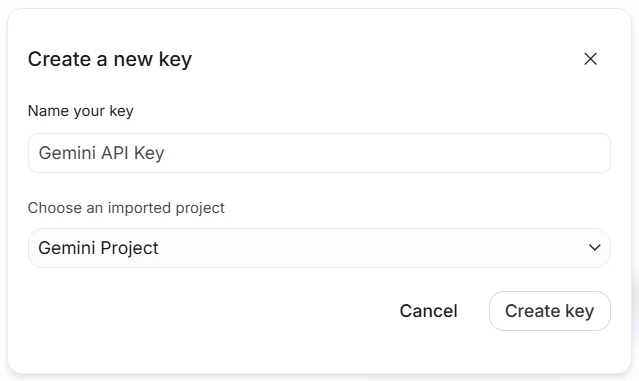
  3. Click "Create API key".
  4. If you have never used Google Cloud, that is the whole of it — Google's documentation says AI Studio “automatically creates a default Google Cloud project and API key after you accept the Terms of Service”. If you already have a Google Cloud account it does not do that: the same page says “AI Studio does not create a default project. Instead, you must import your existing projects” — that is Dashboard → Projects → Import projects, about a minute. If you took the first path you are on the free tier: Google's billing page says “New accounts begin on the Free Tier”, and moving off it “means linking a billing account and prepaying to add a minimum of $10 (or equivalent in other currencies) of credits”, which is something you have to do on purpose. If you took the import path, check rather than assume — Google's terms say your access to the Gemini API is a "Paid Service" "only when accessing the API through a Cloud Project associated with an active billing account", so an existing project that already has billing attached is not on the free tier, and it is the paid wording in the section above, not the free one, that governs what Google may do with what you send. AI Studio's Projects page shows which project a key belongs to. Read on 28 August 2026.
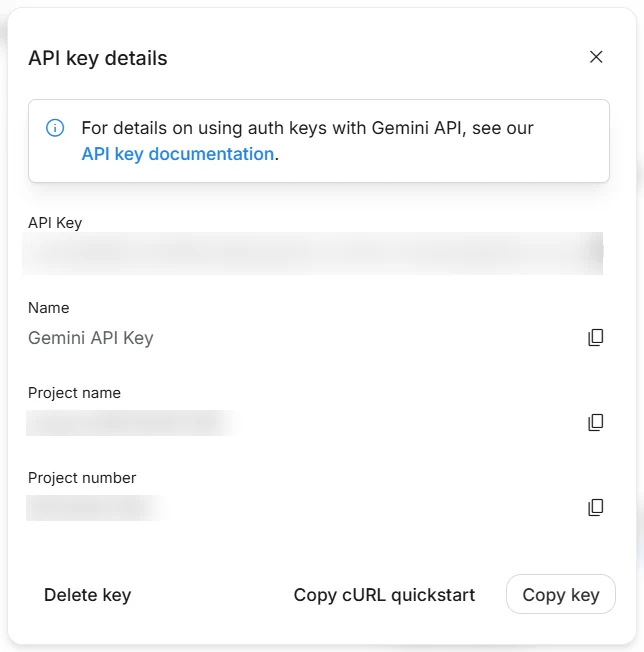
  5. Copy the key that appears — it starts with “AIza”.

Add it to Intellrise

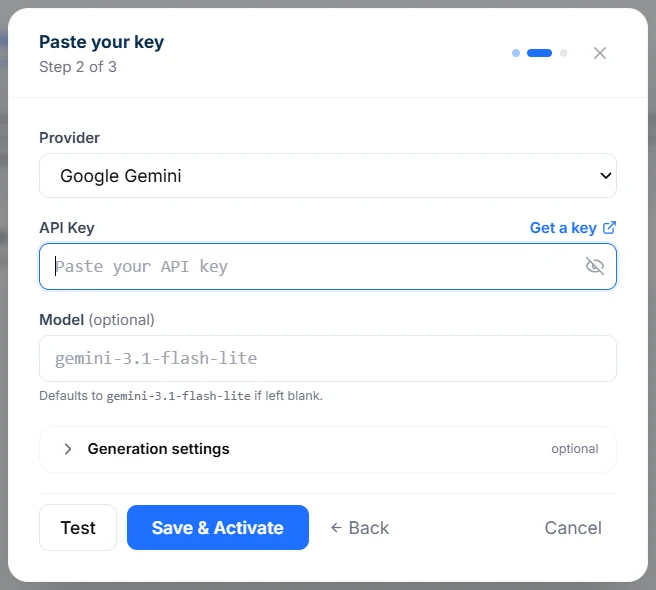
  1. Sign in to Intellrise at app.intellrise.com.
  2. Open Settings → AI Keys.
  3. Paste your key and save. It's stored encrypted at rest (AES-256-GCM) and only ever shown back to you masked.

What it can cost you

Intellrise never bills you for AI usage — we are not in that path at all. The question is what Google can bill you, and the honest answer has a hole in it, so here is the whole thing rather than a reassuring sentence.

Google's pricing page prints "Free of charge" in the input and output price columns for the free tier, and its free plan card lists "Free input & output tokens". A key has no billing of its own: Google's billing page says keys "have no independent billing settings; they inherit the tier limits and billing status of the project", and a project you create from scratch starts on the free tier — "New accounts begin on the Free Tier" (a project you imported may already have billing on it; the step above says how to check). Moving off it is something you have to do on purpose: "Upgrading from the Free Tier to the Paid Tier means linking a billing account and prepaying to add a minimum of $10". And if you run past the free limits, the rate-limit page says "exceeding any of them will trigger a rate limit error" — an error, not an invoice. All read 28 August 2026.

The hole: Google does not print the sentence you actually want, which would read something like "a project with no billing account can never be charged". We looked for it on the pricing, billing and rate-limit pages on 28 August 2026 and did not find one, so we are not going to put it in Google's mouth. The quotes above are what it does say.

If you do enable billing and want a ceiling, Google has two different things with confusingly similar names. An ordinary budget only emails you: "Setting an alerts-only budget doesn't automatically cap Google Cloud or Google Maps Platform usage or spending." A spend cap budget does stop the service — "When a spend cap budget is enforced, usage of your specified services is automatically paused until you manually lift the spend cap" — and Gemini API is on its eligible list, though the feature is in Preview. AI Studio separately offers per-project spend caps, which Google labels Experimental and warns you can overrun: long-running tasks "may incur overages beyond your project spend cap". All read 28 August 2026.

Good to know

Your free-tier limits are shown in AI Studio itself — as above, Google no longer publishes them in its docs, so we do not put a number on them here either. Any AI-usage charge, if you have enabled billing on that project, comes from your provider rather than from Intellrise.

You can change or remove your key anytime under Settings → AI Keys.